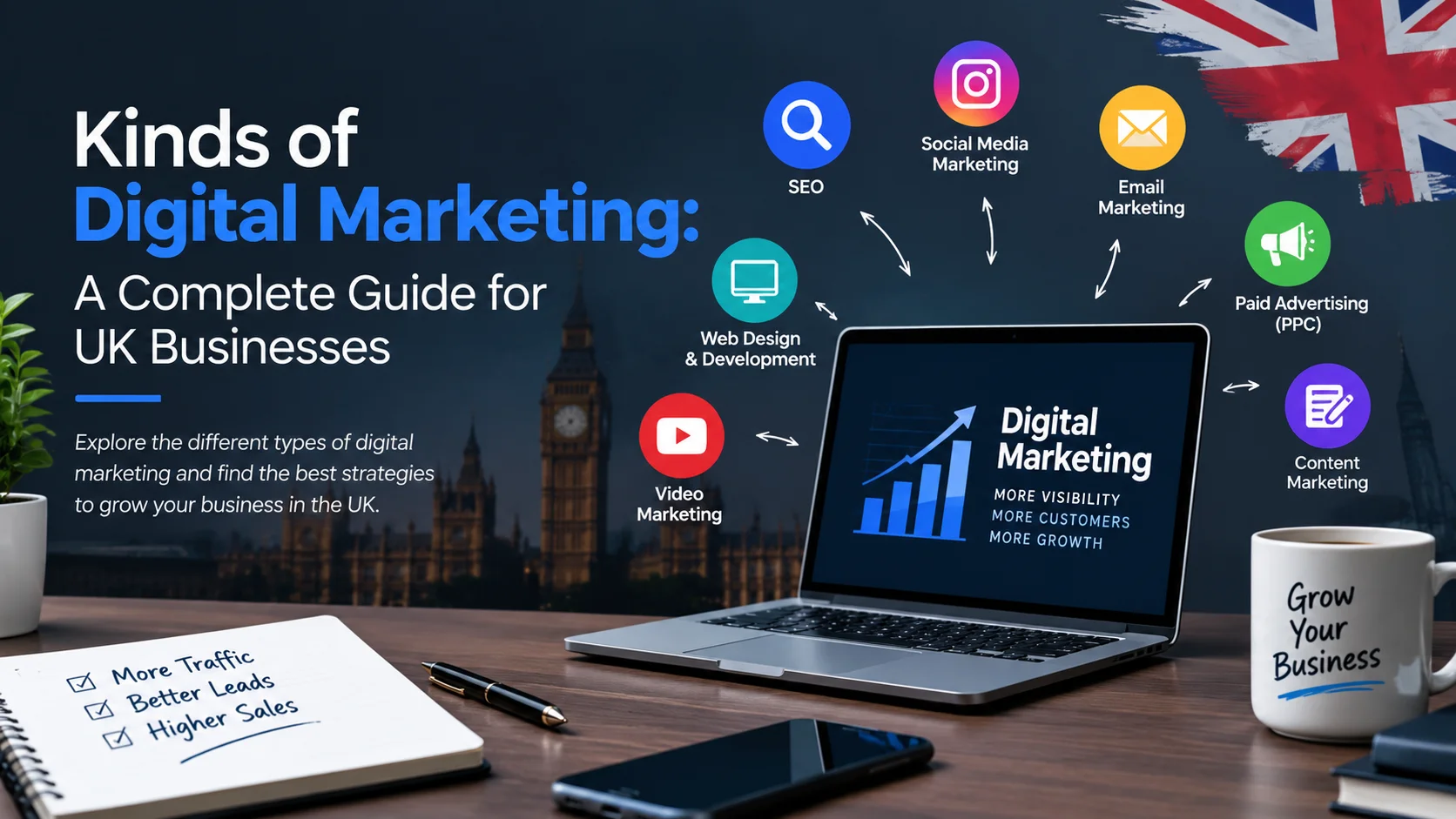
“Digital marketing” gets used as if it’s one single thing, but it’s really an umbrella term covering a dozen genuinely different disciplines, each with its own skills, tools, and best use cases. If you’re a business owner trying to work out where to actually spend time or budget, that vagueness makes the decision harder than it needs to be. This guide breaks down every major kind of digital marketing in plain English, what each one does, and when it’s actually the right fit, so you can make an informed decision rather than guessing.
1. Search Engine Optimisation (SEO)
SEO is the practice of improving a website so it ranks higher in Google’s organic, unpaid search results. It covers technical site health, on-page content, and building genuine authority and trust signals over time. Its biggest strength is that it keeps working without ongoing ad spend once established; its biggest trade-off is that it takes time to build. SEO tends to be the right starting point for businesses playing a longer game, or looking for sustainable visibility rather than a quick, temporary spike.
2. Pay-Per-Click Advertising (PPC / Google Ads)
PPC advertising, most commonly through Google Ads, puts your business directly in front of people actively searching for what you offer, and you pay only when someone clicks. Unlike SEO, visibility is immediate, but it stops the moment spending stops. This makes PPC particularly effective for businesses that need fast results, are launching something new, or want to test demand for a service before investing heavily elsewhere.
3. Social Media Marketing
Social media marketing, primarily Facebook and Instagram advertising for most UK small businesses, works differently to search-based marketing. Rather than capturing people already looking for you, it interrupts a scroll with something relevant enough to stop for, based on interests and behaviour rather than an active search. It’s particularly strong for visually driven products, building brand awareness, and reaching people who don’t yet know they need what you offer.
4. Content Marketing
Content marketing means creating genuinely useful material- blog posts, guides, videos- that attracts and informs an audience rather than directly selling to them. Done well, it builds trust, supports SEO by giving Google fresh, relevant content to index, and increasingly feeds AI-powered search tools that pull direct answers from well-structured content. It’s a longer-term investment, but one that compounds; older content keeps attracting new visitors long after it’s published.
5. Email Marketing
Email marketing remains one of the highest-return digital channels available, largely because you’re reaching people who’ve already chosen to hear from you. It’s particularly effective for nurturing leads who aren’t ready to buy immediately, re-engaging past customers, and building repeat business from an existing audience, something entirely new-customer channels like PPC or social ads can’t do as efficiently.
6. Website Design and User Experience (UX)
Every other kind of marketing on this list eventually sends traffic to your website, which makes web design and UX arguably the foundation everything else builds on. Good web design and development means a site that loads fast and looks professional. Good UX means that site is actually easy to use, clear navigation, an obvious next step, minimal friction between interest and action. Strong marketing paired with a weak website is one of the most common ways businesses waste budget across every other channel on this list.
7. E-commerce Marketing
E-commerce marketing covers the specific practices involved in selling products online: product page optimisation, checkout experience, platform selection, and the marketing needed to drive traffic to a store specifically built to convert browsers into buyers. It overlaps with several other kinds of marketing on this list, SEO, PPC, social media, but applies them with a sales-focused, transactional lens rather than a general awareness one.
8. Mobile App Marketing
For businesses with, or considering, a dedicated mobile app, this covers everything from app store optimisation to push notification strategy and in-app engagement. It’s a more specialised kind of digital marketing, relevant mainly for businesses with genuinely frequent, repeat customer interactions, where an app earns its place over a standard mobile-friendly website.
9. Marketing Automation and AI-Driven Marketing
This is one of the newer, fastest-growing kinds of digital marketing: using automated systems to handle repetitive tasks, instant lead follow-up, missed-call responses, review requests, booking confirmations, so nothing falls through the cracks without needing a person available around the clock. Rather than replacing the other kinds of marketing on this list, automation typically supports them, making sure the leads generated by SEO, PPC, or social media are actually followed up on quickly.
10. Affiliate and Influencer Marketing
Affiliate marketing pays other people or businesses a commission for referring customers to you, while influencer marketing pays individuals with an engaged audience to promote your product or service directly. Both work by borrowing someone else’s existing trust and reach rather than building your own from scratch. These tend to suit product-based businesses, particularly e-commerce, more than local service businesses, though the right partnership can work for almost any industry.
Which Kinds of Digital Marketing Does Your Business Actually Need?
Almost no business needs every kind of digital marketing on this list at once, and trying to do everything simultaneously with a limited budget usually means doing everything poorly. A more realistic approach: get the foundation right first- a genuinely good website with solid UX- since every other channel depends on it. Then choose one or two channels that best match your actual goals: SEO and content marketing for long-term, sustainable visibility, or PPC and social media for faster, more immediate results, and add marketing automation once there’s enough enquiry volume for it to genuinely earn its place.
A few honest questions help narrow this down further. How quickly do you genuinely need results? Days and weeks point toward PPC and social ads, while months and years of sustainable growth point toward SEO and content. Is your offer something people actively search for, or something they need to discover? Active searches suit SEO and PPC; discovery-led products suit social media and influencer marketing. And how much can you realistically commit to consistently? A channel run inconsistently for a few months, then abandoned, rarely outperforms a single channel run properly and continuously.
Frequently Asked Questions
What’s the difference between SEO and PPC?
SEO builds long-term, unpaid visibility in Google’s organic results and takes time to mature. PPC delivers immediate visibility through paid ads but stops the moment spend stops. Many businesses eventually run both together.
Which kind of digital marketing gives the fastest results?
PPC advertising and social media ads typically deliver the fastest visible results, since they don’t require building organic authority first, unlike SEO or content marketing.
Do small businesses need all of these kinds of marketing?
No. Most small businesses see better results focusing on one or two channels that genuinely match their goals and budget, rather than spreading limited resources thin across everything at once.
What’s the best starting point for a business with no digital marketing at all?
Usually a properly working, mobile-friendly website with clear UX, since it’s the foundation every other channel eventually relies on, followed by whichever single channel, SEO, PPC, or social media, best matches how quickly you need results.
Can these different kinds of digital marketing work together?
Yes, and for many established businesses, combining channels performs better than relying on just one. SEO and content marketing build long-term organic visibility, PPC and social ads capture demand immediately, and email marketing and automation keep nurturing leads generated by every other channel, rather than letting them go cold.
How much does digital marketing typically cost for a small business?
This varies enormously depending on which channels you choose, your industry, and how competitive your market is. There’s no single honest number that applies to every business; a proper conversation about your specific goals gives a far more useful answer than a generic figure.
How XpertRanker Can Help
We’re XpertRanker, a digital marketing agency based in Stockton-on-Tees, working with businesses across Teesside and the wider UK. Rather than specialising in just one of the kinds of marketing covered above, we offer the full range under one roof:SEO, Google Ads, Meta Ads, website design and development, UI/UX design, e-commerce solutions, mobile app development, and AI automation so that you can work with one team you trust instead of piecing together multiple suppliers.
If you’re not sure which kind of digital marketing is actually right for your business, that’s exactly the conversation we’re happy to have, honestly, and without steering you toward whichever service happens to be easiest for us to sell. Get in touch with XpertRanker to talk through what would genuinely make the biggest difference for your business.
For more tips like this, follow us on Facebook and LinkedIn.